
SUNN Post Exclusive
“I’ve seen, driving down Foothill, once you get to Pacoima, the flower buckets just sitting there. It’s a weird, almost apocalyptic feeling of, ‘Where’s the vendor? Where did they go?’ They never leave those flower buckets. That’s their livelihood, and to see an abandoned flower bucket, you know something happened.”
C.P. is a Los Angeles native who has lived in the San Fernando Valley her entire life. She said that the state of the city over the past few weeks has been unlike anything she has ever seen.
On June 7, the Trump administration announced that the National Guard would be deployed in Los Angeles for 60 days to mitigate Immigration and Customs Enforcement protests, at a total cost of approximately $134 million. Two days later, 700 Marines were mobilized, joining the 2,100 members of the National Guard.
President Donald Trump sent in these reinforcements to assist with protests within a small area of Downtown Los Angeles near City Hall and federal buildings. Despite some focus placed on the occasional vandalism, arson and rock-throwing, the protests as a whole throughout the county are largely peaceful. Los Angeles Mayor Karen Bass said the majority of arrests the first night of curfew enforcement, June 10, were for violating that curfew or failing to disperse, none for violence or vandalism.
C.P. has children, godchildren, grandchildren, nieces and nephews in Los Angeles, not to mention the rest of her family. To her, the arrival of military forces feels not only unnecessary but deeply personal. She speaks with the urgency of someone who has seen her neighborhood misrepresented before, but never quite like this.
“The city was not burning before they sent in the National Guard, before they sent in United States Marines, on their own citizens,” C.P. said. “I have family members who are retired Marines, and they are disgusted. There’s nothing for them to do; the city’s not burning. They want to push out this narrative that LA is burning […] We’re scared, but our city is not burning.”
Bass, California Governor Gavin Newsom and LAPD Chief Jim McDonnell have all spoken against the involvement of the extra enforcement.
“We are nowhere near a level where we would be reaching out to the governor for National Guard at this stage,” McDonnell said.
McDonnell’s words came in response to President Trump’s June 11 statement: “If we didn’t bring in the National Guard and the Marines, you would probably have a city that was burning to the ground just like it was a number of months ago with the housing.”
President Trump has frequently posted about the National Guard and Marine involvement in Los Angeles on his Truth Social platform. Such posts include similar statements about the necessity of the deployment and Newsom, Bass and McDonnell’s lack of control around the situation.
He also repeatedly posted his anger at protestors who wear face masks, declaring that “from now on, MASKS WILL NOT BE ALLOWED to be worn at protests. What do these people have to hide, and why???” and “ARREST THE PEOPLE IN FACE MASKS, NOW!”
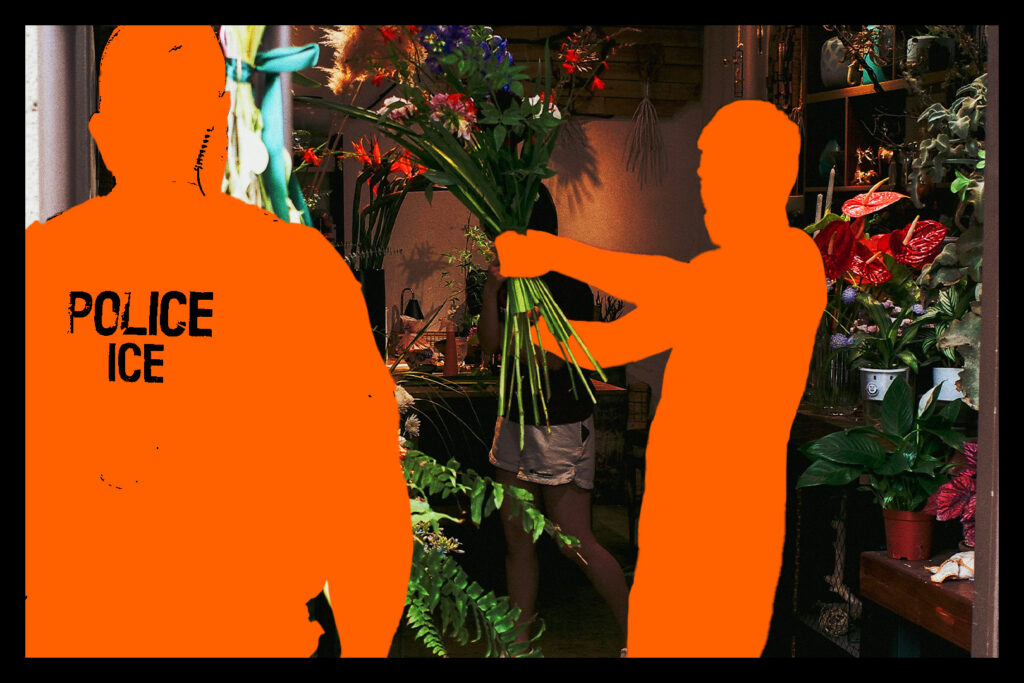
C.P. said she is frightened by the ICE agents, all wearing face masks, who roam her community. She cannot imagine how much more fear non-English speakers must feel in similar scenarios.
“The fear is, for the undocumented or even for those of us who have documents, the lack of transparency,” C.P. said. “Why are you covering your face? How do I know you are who you say you are? The cowardice behind that. Where’s your badge? Identify yourself. As a woman, as a minority woman, I’m scared to leave my house.”
In the two weeks since the National Guard deployment, ICE activity visibly increased across Los Angeles. Agents have been spotted at parks, pharmacy parking lots, grocery stores, home improvement stores and more. C.P. said her local markets in Pacoima, a predominantly Hispanic community, are eerily empty. Despite her fears, she said she still seeks out ways to help her community, frequently spreading the word among her friends when she catches wind of suspicious-looking trucks heading to specific locations.
“I’m a U.S. citizen. I’m biracial. My dad was African American. My mother is Hispanic. For me to stay quiet and to sit silent while my community, my people, my friends, my family—it’s impossible,” C.P. said. “I drive around my neighborhood at night, every single night, because there are taco vendors on the street. If I see something, I’m honking my horn, I’m screaming, I’m yelling. They’ve already been in my neighborhood once.”
In addition to residential and commercial activity, on June 19, Dodger Stadium’s official X account posted that they denied ICE agents’ request to access their parking lots that morning; however, ICE’s official account responded to the post about an hour later.
“False. We were never there,” the post said.
Dodger Stadium is located in the Elysian Park neighborhood, another predominantly Hispanic community.
To C.P., the rising tension is not just about immigration policy; it is about the way certain communities are treated and portrayed in public discourse. She believes that the larger cultural conversation around immigration is charged by racist, discriminatory rhetoric.
“How come nobody ever asked why they wave an Irish flag? No one’s ever offended at that, ever,” C.P. said. “But the second they see a Mexican flag or a Salvadorian flag or a Honduran flag or a Guatemalan flag, they clutch their pearls and they gasp. Why are you so offended by that? The racism is so blinding.”
C.P.’s husband is a Permanent Resident, yet her family is scared, much more so than they were during President Trump’s first term. She said they have canceled social events and will not allow him to go outside, even to sit on the front porch, by himself. They constantly carry his residency card, which had previously been stored with other important documents in a home safe.
“Last administration, they came for Black Lives Matter, but nobody was being snatched off the street,” C.P. said. “This time, we’re seeing people snatched off the street. Our local taco guy, our local elote man—we’ve never seen anything like this before. I’ve never been afraid to leave my house. This is the first time in my 47 years I’m afraid to leave my home.”
C.P. emphasized that the fear spreading through her neighborhood and the county as a whole was not limited to any single community.
“This isn’t just an invasion on one specific group,” C.P. said. “It’s an invasion on everybody.”