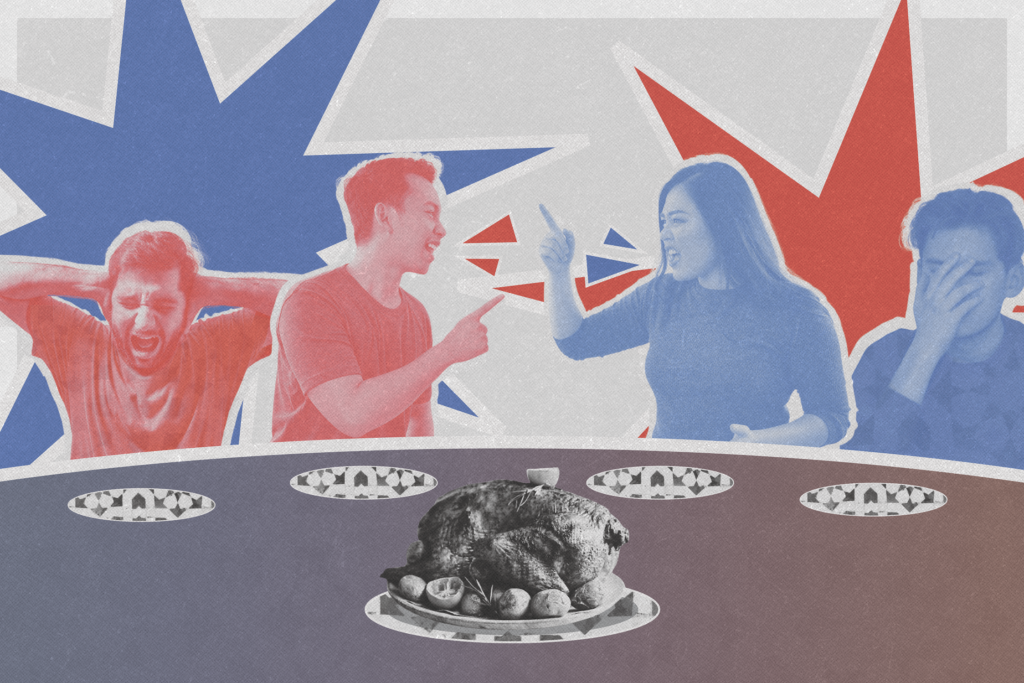
Next week, families across the U.S. will reunite to share turkey, mashed potatoes and political opinions. Conversations at the Thanksgiving table may include celebrations of one another’s accomplishments and updates on life events, but may also stray into more controversial territory — for some families, the dinner table could become a political battleground.
Polarization runs deep in America’s current political landscape: As of 2022, almost three-quarters of Republicans viewed Democrats as “immoral,” and 63% of Democrats returned the favor. BridgeUSA is a nonprofit organization dedicated to empowering young people to engage in constructive dialogue. Jaya Dayal, BridgeUSA’s learning and development manager, leads BridgeUSA’s workshop programs among young people.
“Polarization is one of the biggest issues we deal with,” Dayal said. “Polarization becomes a barrier to us just being able to even engage with each other in the first place. Through polarization, this idea that we’re willing to write off someone before we actually know them to make these assumptions about someone’s value and whether or not they should be someone we work with or whether their opinion matters.”
Drew Spiegel, the president of Vanderbilt University’s College Democrats group, has seen firsthand how political stereotypes can raise tensions in cross-partisan conversations like those that may arise at the Thanksgiving table. “I think as we get to know people better, a lot of times certain judgments are proven wrong,” Spiegel said.
Braver Angels is a nonprofit organization aiming to equip Americans with the skills to practice courageous citizenship. Braver Angels moderator forum coordinator Mary Thomas-Vallens helps thinkers on both sides of the aisle challenge their own stereotypes with one Braver Angels exercise. In the exercise, participants are split up by political affiliation, then tasked with brainstorming stereotypes opponents may level against their party. Afterwards, participants reconvene to address misconceptions and discuss where stereotypes may stem from. “They’re broken down when people share those perceived stereotypes,” Thomas-Vallens said. “Humility is what brings people together. It opens a door.”
Sometimes, breaking down stereotypes fails to resolve key ideological conflicts. In these cases, RaeAnna Morales, a senior at Vanderbilt University who heads the university’s College Republicans chapter, believes conversations over the Thanksgiving table can pivot to focus on “common ground.”
“There are certain things that everyone can agree on,” Morales said. “Bringing up those are really important, whether it’s just to start off Thanksgiving, or if you find yourself in a situation where it is politically heated or a disagreeable conversation.”
In fact, common ground may be easier to find than Americans would think. Views on topics like violent crime and affordability are generally similar across both parties. In fact, Dayal believes the results of this month’s midterm election can also offer a starting place for respectful and productive dinner table conversation.
“Regardless of which side it shifted towards, I think that opens up a conversation for why so many people who maybe voted one way in 2024 felt like they should vote for a candidate that aligned differently in 2026,” Dayal said. “It creates a great opportunity for some really interesting questions and conversations if there was something that was different in the past, and things that we’re hopeful for or want to see from our elected officials in the next two years.”
Dayal is not wrong — voting behavior swayed. Eight of the 20 Senate seats Democrats picked up this November came from states President Donald Trump won in 2024.
Spiegel believes that the goal of dialogue should be to walk away from a conversation with a member of the opposite party having learned something new. “My general rule is I try to pick battles where I think that the conversation can lead to something productive,” Spiegel said. “That doesn’t need to be one person changing their mind or somebody agreeing to pass a bill or vote for a bill or anything.”
Dayal also continued to stress the importance of speaking respectfully. “We’re going to address statements and not people,” Dayal said, sharing guidance she uses with clients at BridgeUSA. “We’re going to view people as individuals, as humans.”