
The first message I saw when I woke up was jarring: Check the news. Followed by a second, framed with sarcastic sparkle emojis and accompanied by a photo of the morning headlines: Sh*t’s bad.
BREAKING: Local lawmakers shot. I ran downstairs and turned on the daily news. To my shock, the headlines containing the word “shot” quickly turned to using “killed.”
Early on the morning of June 14, two Minnesotan politicians and their spouses were targeted by an assassin in disguise as a police officer. Two survived with serious injuries. Two were not so lucky.
The attacker, Minnesota native Vance Boelter, went to the home of State Sen. John Hoffman and his wife, where he shot Sen. Hoffman eight times. Police responding to the event decided to check on the residence of State Rep. Melissa Hortman, who lived nearby. There, they encountered the assassin, who shot and killed Hortman, her husband and their dog. The assassin fled, but Minnesota police apprehended him two days later near his rural home with the assistance of civilian tips.
I had a hard time believing what I was reading that first day. I didn’t doubt it, but it caught me off guard. I was keenly aware of historical and recent examples of political violence that had happened elsewhere in the country, but I’d never expected it to occur in my home state. The preeminent stereotype about Minnesotans is that we’re passive and generally nice; this event was decidedly out of sync with my understanding of our state culture.
My friend’s feeble stab at humor as they broke the news to me masked a deeper truth. Beneath those sparkles, we both understood what was becoming painfully clear about ourselves and other Americans in this era: we are exhausted. Exhausted by the repetition, the senselessness, the violence that cycles and escalates without end. We are angry. We are grieving. And we are done pretending this is normal.
We — our generation, our leaders, and anyone with a stake in tomorrow — must channel that fury into something that endures and energizes. Minnesotans may have just provided the blueprint.
The attempted assassinations of Representative Hortman and Senator Hoffman are not random acts. They are symptoms of a deep, festering rot.
The assassin’s intentions were at the very least anti-Democrat, but he played with tipping points in our legislature. Had the gunman succeeded at assassinating all his intended targets, Republican control over both state chambers would have been secured, at least temporarily. There are 134 seats in the Minnesota House of Representatives and 68 needed for a majority. Prior to Horman’s death, the seats were split exactly 67-67. With Hortman gone, balance has tipped — though Gov. Walz has called a special session to replace her seat.
The Minnesota Senate was also closely contested: the chamber’s majority was 34-33, favoring Democrats. Following the death of Sen. Kari Dziedzic (D) on December 27, 2024, the chamber was tied 33-33 with one vacancy. Had Hoffman or one of the assassin’s other potential targets from the hit list he was found carrying been killed, balance would have tipped further right.
Authorities and politicians have described the attack as “politically motivated.” When looking at the attacks from the lens of party control in an unusually evenly split House and Senate, the violence appears chillingly calculated. This is the most extreme form of what is now a national epidemic: protesters handcuffed while insurrectionists walk free, all under the gaze of a White House that legitimizes violence against those who dissent. It’s not just inaction — it’s endorsement.
Minnesota, like much of this country, has long contended with far-right extremism. From Minnesota Senator Ernest Lundeen, who was carrying a speech written by Nazi propagandist George Sylvester Viereck when he died, to aviator Charles Lindbergh, a eugenicist idolized by the America First movement, the pattern is familiar: Americans turning from our own failures toward charismatic figures offering blame, not solutions. The faces have changed, but the tactics haven’t.
This pattern isn’t disappearing either, only evolving. When political leaders pardon those who commit violence on their behalf, and when elected officials fan the flames of conspiracy and hate, they send a clear message to their followers: violence isn’t just tolerated; it’s useful.
Minnesota is still reeling from the tragedy, but here, at least, our politicians are taking a stand. Sadly, that isn’t true for every state. Republican Senator Mike Lee of Utah mocked the tragedy. Meanwhile, the president has refused to offer any condolences to Governor Walz. Instead, when speaking to reporters the Tuesday after the attack, he stated that the governor was “wacked out” and that “He [Walz] appointed this guy,” echoing misinformation circling right-wing social media that Walz personally appointed the assassin to a local labor advisory board. Boelter first gained admission to the board in Mark Dayton’s tenure along with thousands of other volunteers from all parties appointed to a range of boards and committees.
I used to think that Minnesota was paradise. It was a bubble where I felt that I could trust our leaders to make decisions that would keep their constituents safe. But the waking dream I once had of a quiet, unwounded state is shattered. While Minnesota is contending with the aftermath of homegrown violence, the White House claims that the country’s most pressing threats are elsewhere — in the Middle East, or at the border. But the immediacy of issues matters. While we’re supposed to be worried about Iranian sleeper cells that could attack us, a U.S. national already did.
It’s time to be angry. It’s time to be emotional. This cannot be another tragedy swallowed by the constant churn of breaking news. What happened here can happen anywhere unless we commit to making real, substantive change.
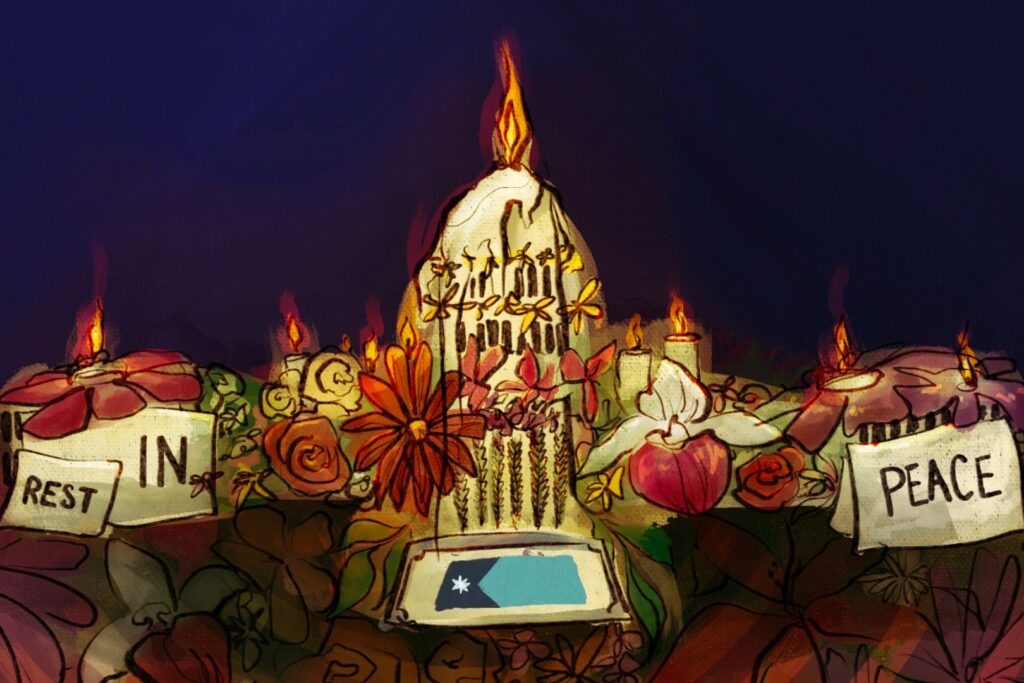
That image that greeted me when I woke up on Saturday morning — that glib sparkle text over a breaking news banner — stayed with me when I went to Representative Hortman’s vigil. As the sun set in front of the Capitol, Minnesotans clustered on the lawn, forming a ring around the memorial to the Hortmans. Strangers shared candle guards with one another, knelt shoulder to shoulder as they wrote their thanks to Rep. Hortman on a thin white sheet and shared their memories of her or the impact of her policies on their personal lives. On the steps where my friends and I had stood three weeks ago, frantically adjusting gowns so we’d look presentable for prom photos, a quartet from the Minnesota orchestra played a somber tune.
We should be proud of peaceful assembly in this country, whether we agree with the inciting cause or not. What I saw at the Capitol reaffirmed my pride in being Minnesotan. I was and am deeply impressed with how well-informed the people around me are and how many people still turned up to the “No Kings” protest that same day the news broke, despite the tragedy of the morning. Marching from the Capitol to the Cathedral, Minnesotans filled the bridges over I-35W, holding up homemade signs as cars passing underneath honked their support. There and at the vigil, I saw people from all walks of life take on a hundred forms: activists for democracy, storytellers and memory-bearers, shoulders to cry on.
This is the America that our national government and bad actors like the assassin are attempting to erase, a country where people are proud to speak their minds, unwavering in their support of one another and confident in the belief that life is not disposable. This is the America worth defending.
As Republican House Minority Leader Lisa Demuth rightly and bluntly put it, “political violence is abhorrent and unacceptable.” We’ve been watching and waiting for responsible leaders — leaders who will listen to our concerns, who will have the courage to condemn divisive rhetoric, who will not excuse extremist actions or mock those grieving and who will acknowledge the harm that guns cause.
There is no good ending to this story, at least not yet. Our country is marked with wounds, but they will only grow deeper if we turn our attention away. By merely intellectualizing the Hortmans’ murder — or worse, by not thinking about it at all — we are perpetuating a cycle of deaths becoming merely another statistic and are thereby complicit in making extremism normalized.
Democracy relies on understanding and being willing to hear the perspectives and feelings of all citizens. Indifference poses a threat to this: it leads to complacency, disengagement and inaction. Empathy and active participation must stay a central element of politics if we hope to create positive political transformation, and we have to rely on our hope to sustain that transformation.
We must make it known in our words, in our actions and in our writing that such violence is abhorrent, that the language that encourages or refuses to condemn these actions is unacceptable, and that domestic terrorists cannot enjoy the impunity they have in the status quo. It’s time to be hurt, and sad, and empathetic and to turn feelings into words and action. If the change will not come from above, then it’s our responsibility to change that precedent — if not for our generation, then for the next.