This story is syndicated from Scot Scoop News, the newspaper of Carlmont High School in Belmont, CA. The original version of the story ran here.
In 2025, your politics aren’t just your opinion, they’re your identity. When Brandon Wu showed up to school wearing a red MAGA hat, the reaction wasn’t just disagreement — it was an onslaught of aggressive backlash.
Other students were offended by Wu’s political statement and confronted him head-on.
“They circled me in our lunch area and started throwing their food. [One student] basically went up to me and just started saying, ‘I want to debate, I want to debate,’” Wu said.
This confrontation quickly escalated, with the situation intensifying throughout the day.
“They quite literally ganged up on him. They circled him, kept on harassing him and pestering him for an entire day in the parking lot,” Samuel Low, Wu’s friend and fellow senior, said.
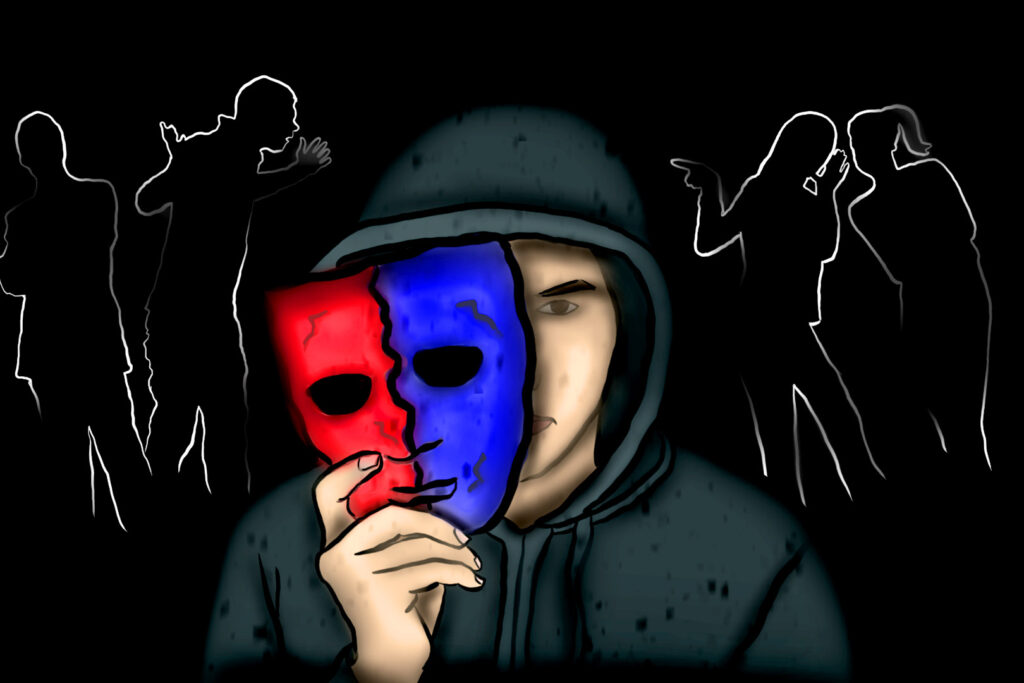
The trend of public confrontation isn’t unique to either side. Whether we admit it or not, political beliefs have become a marker of identity — and a reason to exclude or confront others. This kind of social judgment links directly to the broader trend of political polarization, the movement of political views and actions away from the center and toward more extreme views and policies.
According to a study from the National Bureau of Economic Research, while political polarization is growing in other countries worldwide, it is happening much faster and more dramatically in the United States.
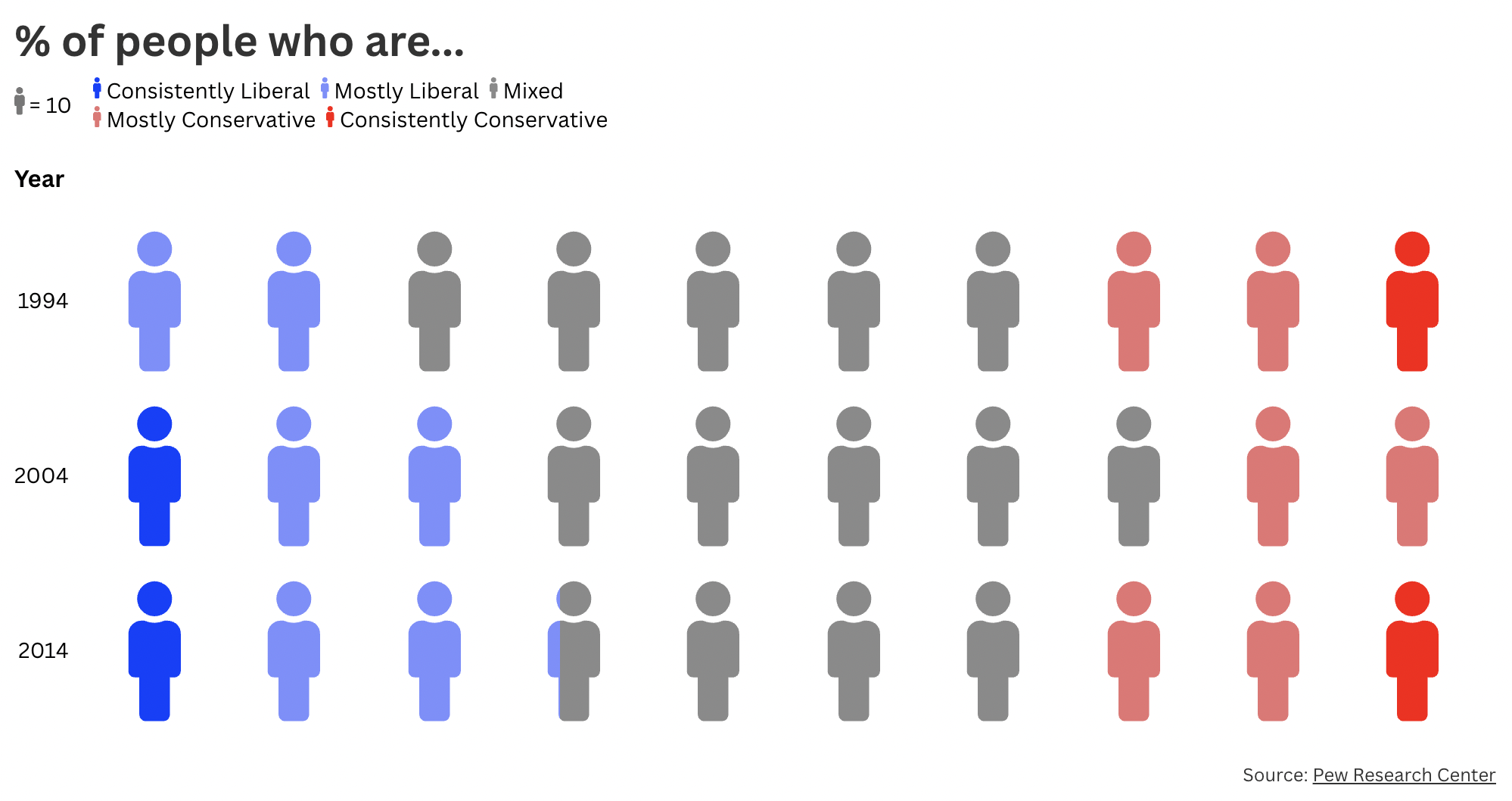
Polarization has only intensified with Generation Z, reshaping both our politics and social lives. According to a report by Pew Research Center, the number of people with political views in the “center” has decreased from 49% in 1994 to just 39% in 2014, and continues to decline.
Politics have taken on a moral focus as part of this new climate.
“Your political views aren’t simply an ideology. They lead to laws and policies that affect everyone, and people’s decisions lead to different outcomes,” said Carlmont freshman Lana Fitterer.
As individuals’ beliefs become more tied to their identity, political discourse becomes more charged. Critiquing a policy can feel like questioning someone’s character. The result is a political climate where opposing views are often treated as threats, not just alternatives.
“Nowadays, a lot of human rights issues have become politicized. People feel like when someone votes a certain way, they’re directly infringing on someone else’s rights or beliefs, causing a lot of judgment. But I don’t think politics was ever meant to work that way,” said Sweekriti Ratman, a Carlmont junior and the president of the Political Science Club at Carlmont.
Confrontation that’s otherwise taboo starts to look like the only moral option, to restore rights. When the harassment continued for Wu, he found himself repeatedly drawn into debates that seemed to have no end.
“They just wanted to debate unprovoked,” Wu said.
The students repeatedly verbally attacked Wu, allowing their emotions to take over their rational thought, he said. In truth, they were all high school students going to the same school in the same grade, but the difference in their political ideology created a gap larger than ever.
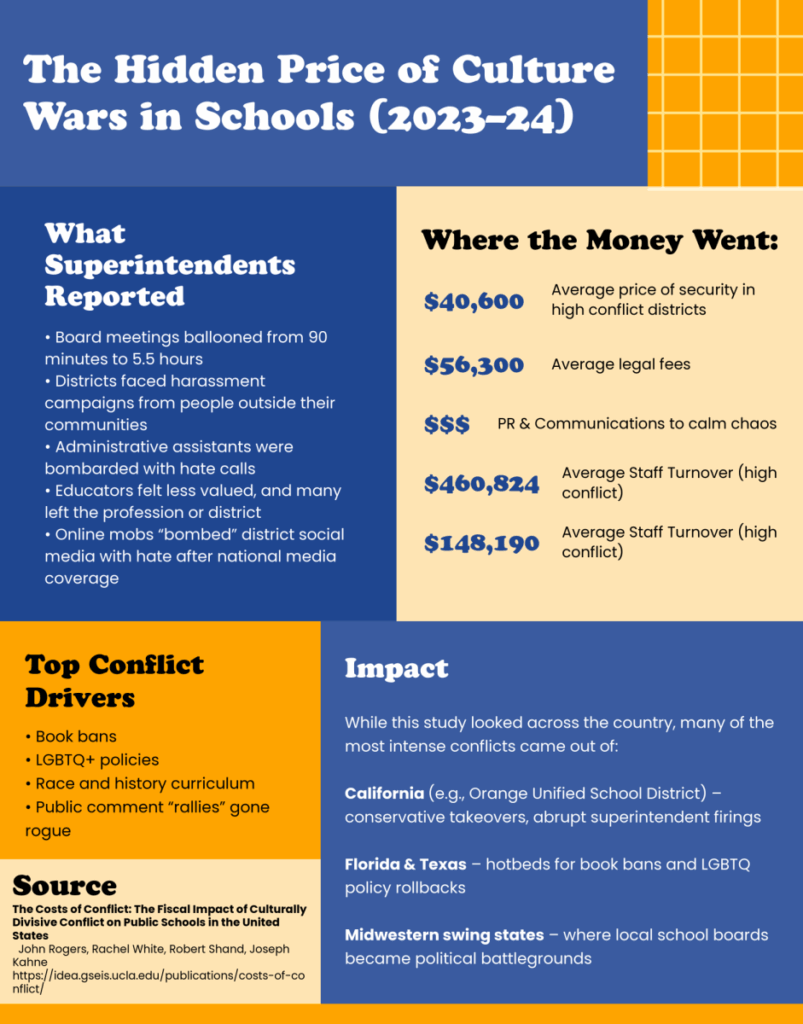
Across the country, schools have seen a rise in political conflicts, especially in the wake of the 2024 election cycle. A national survey by University of California, Los Angeles and UC Riverside researchers found that over two-thirds of high school principals reported substantial political conflicts within their communities.
Furthermore, a UCLA study estimated that districts nationwide spent $3.2 billion in the 2023–2024 school year addressing “culturally divisive conflict.” This included expenses for increased security, additional staff time, and efforts to manage staff turnover.
“It’s absolutely ridiculous. We should welcome political discussions, but definitely shouldn’t be so aggressive about it,” Low said.
While mediated debate might be healthy, political confrontation can be, students say.
“Political polarization increases hostility and leads to an inability to acknowledge any other side,” said Carlmont sophomore Brandon Shen. “It fuels an ‘us vs them’ problem.”
According to the Center for Legislative Archives, America’s two-party partisanship has roots in the early 19th century as the country’s parties began to explore and form answers around the development of the country.
Pew Research Center data shows that Democrats and Republicans have only drifted further apart since the late 20th century. This divide is no longer confined to political forums — it’s reflected everywhere from dinner tables to TikTok “For You” homepages and represents boundaries about the type of people Americans call friends and family.
Not every student is convinced we need those boundaries, though.
“If you chose Trump over Harris, or vice versa, I don’t think that necessarily makes you a bad person,” said Carlmont sophomore Gabriel Osorio.
Broader political divides are becoming more pronounced with the rise of figures whole parties rally to support — making easy targets for moralism.
“Political divisions are getting worse, especially with more controversial figures like Biden and Trump. Even though these politicians represent certain views, their actions don’t always align with what people agree with,” said Dakota Chang, a Carlmont sophomore.
Generally, political figures are expected to reflect the values of their constituents, but figureheads at the national level rarely help the entire nation at once. Volatile leaders like Trump — whose rhetoric, policies, and the Jan. 6 Capitol riot in 2021 widened partisan divides — have alienated moderate voters at times on purpose. He’s implemented policy to withhold funding from Democratic states over Democratic policies, for instance, including disaster funding.
Additionally, a Pew Research Center study found that regardless of political engagement, most Americans feel that elected officials do not care about their opinions. Specifically, 84% of highly engaged individuals and 87% of less engaged individuals share this sentiment.
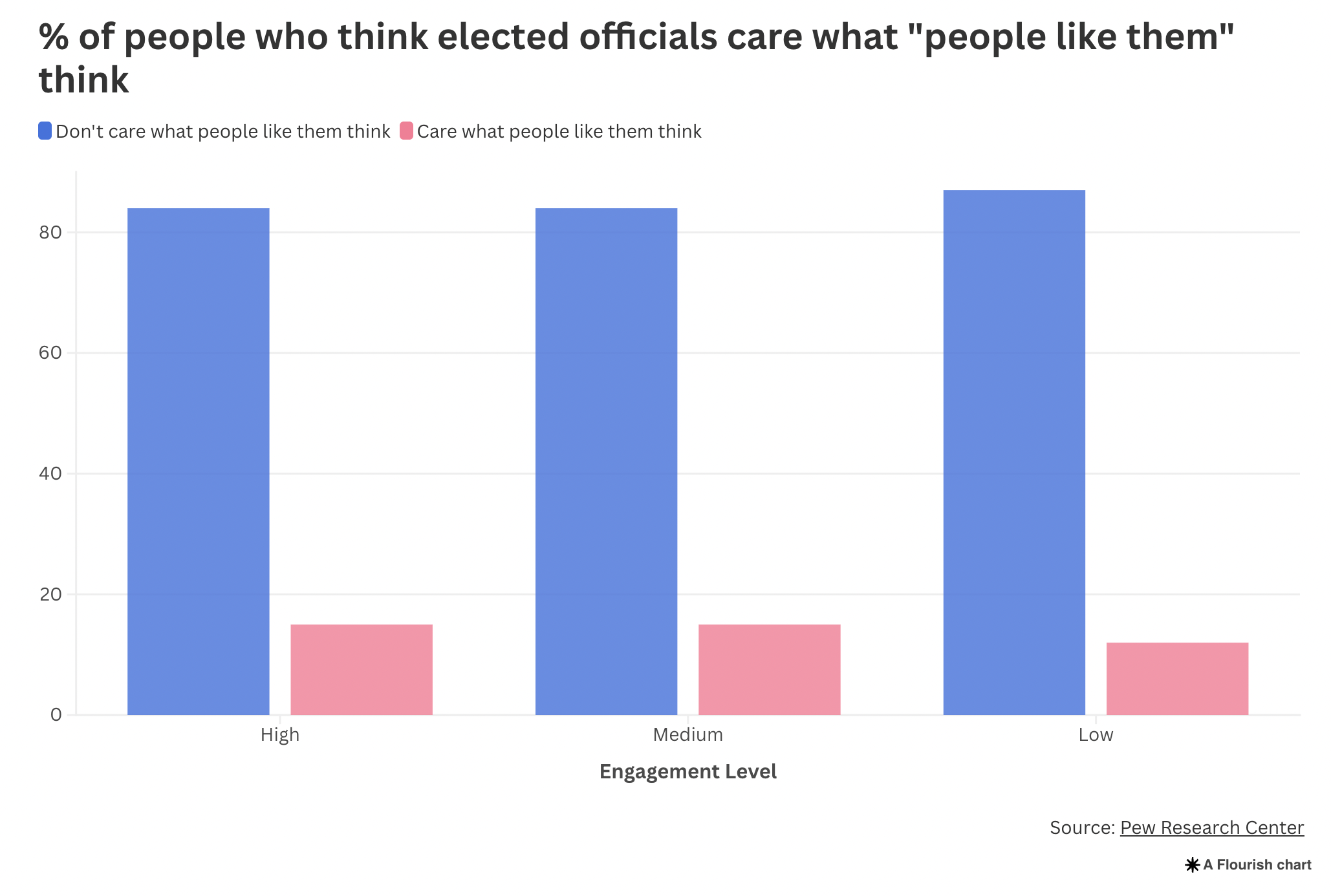
That sense of feeling ignored has raised the emotional stakes of political discussions. What might once have been considered a policy disagreement may spark personal tension, especially around hot-button topics like immigration, foreign policy, and abortion.
“Political ideologies are fundamentally rooted in values of what’s right, fair, and just,” Shen said. “It’s normally an extension of what people morally believe is correct.”
According to Vox, Americans are more likely to hate someone based on politics than based on their racial identity. Political polarization has reached such extremes that it often supersedes other social divisions, such as race. This phenomenon suggests that political identity has become a primary lens through which individuals view and judge one another.
This shift in societal dynamics can be observed locally as well. At Carlmont, the Political Science Club tries to foster open conversation and civic engagement, but even there, students tread carefully.
“There were mixed opinions when we talked about the propositions in the upcoming election cycle. But the propositions themselves didn’t really cause much political division,” Ratman said. “There are a lot of sides to consider, and they don’t always lean toward one party or another.” Some suggest that efforts to gain more participation may somehow balance the extremes of the country. According to research conducted by the Georgetown Institute for the Study of Markets and Ethics, even well-intentioned efforts like boosting voter turnout don’t necessarily reduce division. In fact, they can backfire, drawing previously disengaged voters into the fray with more extreme, polarized views.
With little in place to change these dynamics, political tension will continue to play out in friendships, classrooms, and daily interactions. For many, judging others is not necessarily about criticizing their personal qualities but determining whether they share compatible values and beliefs.
“Judging, to me, means deciding if you want to be around someone or have a role in their life based on what they believe,” said Karena Ling, a Carlmont sophomore.
She explained that while people may try to understand different perspectives, personal beliefs often shape who they choose to be close to.
“I think people should try to hear the other side and try to understand different views — but it’s always a factor when making friends,” Ling said. “People tend to be closer to others who think similarly.”
For some, keeping political talk behind closed doors is how they dodge drama and preserve friendships.
“I don’t think it’s right to bring up politics in public. It should only be discussed in private,” Chang said.
Limiting political discussions to more personal settings helps avoid conflict and maintain a sense of mutual respect among friends and peers.
Despite this, Chang also sees the potential for unity in the face of differing opinions.
“I think there’s still hope for unity. Unity doesn’t mean we all have to agree — it just means accepting that everyone has different views,” Chang said.