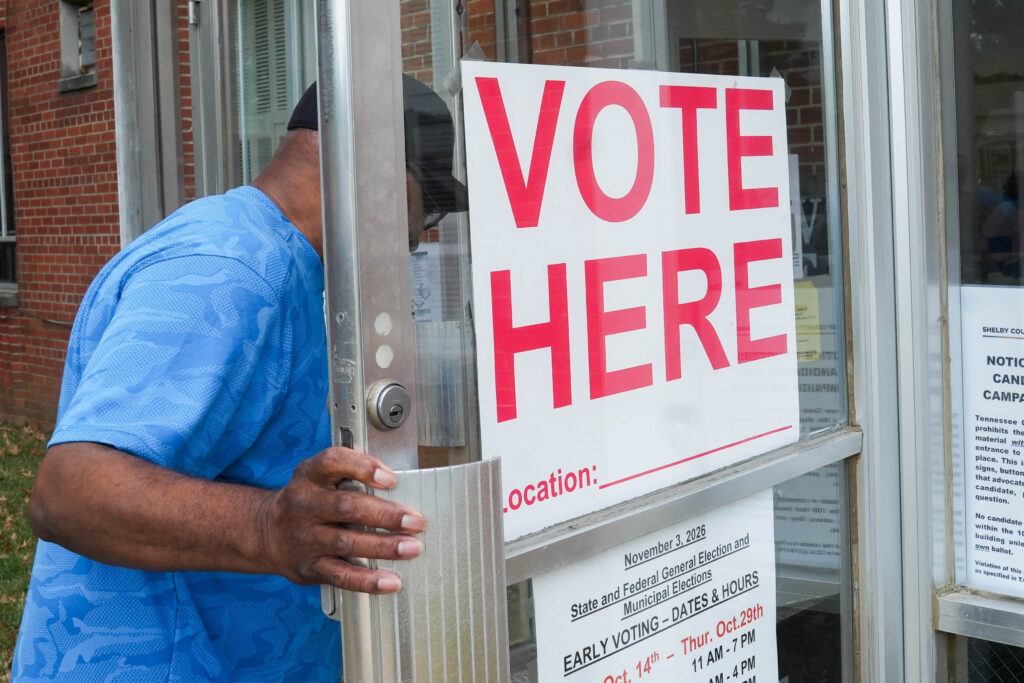
Today, millions of Americans will head to the polls. They’ll fill in the bubbles for their preferred candidates and slap on an “I Voted” sticker. But depending on the area and other factors, they also might have to stand in line for hours — or be unable to get to a polling place or cast a ballot at all.
While voting is seen as easy by many Americans, a meaningful minority perceive barriers — and experts say that access is uneven and imperfect for several parts of the American population. A poll by NPR, Ipsos and the Medill School of Journalism after the 2020 election found that while most nonvoters said voting was easy, 5% said it was very difficult to vote, and 16% said it was somewhat difficult.
For some voters, the hardest part of Election Day isn’t the decision itself — it’s getting to the polls at all. Longer drives, limited budgets, few alternatives to in-person voting and other factors create barriers to voting for certain groups, despite the fact that voting is meant to be one of our cornerstone rights as American citizens. Read on to learn about five of the several groups that face challenges casting a ballot.
Young voters
A survey by Tufts University’s Center for Information & Research on Civic Learning and Engagement (CIRCLE) after the 2024 presidential election found that almost half of eligible youth voted, but that among those who didn’t, a majority faced some kind of barrier. One of the big ones was time. When they asked eligible young people who hadn’t cast a ballot what the main reason was, 17% said “they were either too busy, had other commitments, or had issues like lack of childcare prevent them from voting.”
This year, in North Carolina, the removal of several polling sites from college campuses created access challenges, according to a lawsuit brought in January by the College Democrats of North Carolina from multiple impacted colleges, seeking to stop the closure of the sites before the primary. The suit said that Western Carolina University students without a vehicle — more than half their student population — would be forced to walk almost two miles, partly along dangerous highways, to get to the closest place to cast a ballot. During early voting in October, hundreds of affected college students in different parts of the state marched to the polls anyway.
Voters without a universal mail-in option
Some states, like New York and Massachusetts, give registered voters the option to vote via a mail-in ballot with no questions asked. But that’s not true everywhere. According to a database compiled by Shreya Jha, a human physiology major at Boston University and peer of this reporter, a quarter of states require an excuse in order to get a mail-in ballot, like if Election Day falls on a religious holiday.
Forty-seven states and Washington, D.C., give voters the option to vote in-person early — a big increase since 2016 — but a few still don’t, making standing in line at the polls the simplest option for many. New Hampshire, Alabama and Mississippi have no early voting, except in the case of casting an absentee ballot with an approved excuse.
Rural voters
In-person voting continues to be the most common method for casting a ballot — 70% of voters voted that way in the 2024 presidential election, split almost evenly between doing so early and doing so on Election Day — which is why access to polling locations matters so much. While in urban areas, half of polling places serve an area of less than 2 square miles, in rural areas half of polling places serve more than 62 square miles, according to a 2022 report by Secure Democracy USA. For voters without a reliable car, that trip could be the difference between voting and staying home. According to a 2020 study published by the American Economic Association that examined voting in cities, just a 0.25-mile increase of distance to a polling place reduces the number of ballots cast there by 2% to 5%.
That finding might especially matter for rural voters, since they rely on in-person voting more than urban voters, on average. According to a 2026 Cygnal survey of likely general election voters, 54% of rural voters plan to vote in-person on Election Day, compared to 43% of urban voters.
Low-income voters
Income adds another layer. Less than half of states require employers to offer paid time off for voting, which for someone struggling financially could mean the choice between voting or earning enough money to eat properly that day.
Additionally, among voters with incomes lower than $30,000 in 2016, an analysis by the Washington Center for Equitable Growth found that 5% credited a lack of transportation as the main reason they didn’t vote. People in rural communities tend to earn less than those in urban communities, making reaching the polls a bigger struggle for low-income residents in those areas.
Voters of color
Experts have found that issues of voter accessibility are also exacerbated in communities of color. When it comes to finding a polling place, 5% of white respondents to an American Bar Association survey said they experienced difficulty, in comparison to 15% of African American respondents and 14% of Hispanic respondents. Lack of access to translated voting materials also contributes to lower voter turnout for minorities.
Back in 2018, the U.S. Commission on Civil Rights released a report that found minority voting rights were harmed by multiple new laws and voting procedures, one of which was stricter voter ID laws. Many states continue to enforce similar laws, with Florida having recently passed what is known as its version of the Safeguard American Voter Eligibility (SAVE) Act. Meant to ensure that only citizens can vote, many of the forms of ID that were previously acceptable — like student ID cards and debit cards — will no longer be valid starting next year.