
In nearly every American school, it’s bots all the way down. More and more students use AI to write, and some teachers use it to grade. The humanity that used to be inherent to the academic experience has been mostly replaced, in unlucky cases, with a duel between the outputs of machines. Some of the country’s largest cities, like Los Angeles and New York, have rightly restricted the use of artificial intelligence in classrooms recently, and many concerned citizens want other districts to follow. But to target AI alone neglects a bigger truth: Technology made the best parts of schooling moribund years before Claude and Gemini entered the scene.
When the internet came out, its hyperonline supporters said that computers could become perfect teachers for every individual student, like “Digital Aristotles.” This pitch flopped. But in the mid-2010s, its more tempered cousin, the “one-to-one” model that gives every kid a laptop, caught on like a pathogen. The well-meaning people who bought into it figured that computers shouldn’t replace teachers, but that they could be companions to teacher education, and also cited increases in test scores. Then Covid came, and the one-to-one model became nearly universal — you can’t really have a traditional classroom when the whole world is quarantined. Administrators couldn’t anticipate the full impact of giving all these laptops out to students. No one could.
Six years have passed, and the one-to-one model has failed. Expert opinions make it obvious that isolation in front of a laptop stops the kind of deep learning that actually matters, not to mention the internet’s endless distractions. Neither phone bans nor AI restrictions will undo, on their own, its worst effects. The nuances are labyrinthine, but we have to recognize that laptops in the classroom hurt more than they help. The closer we can get to eliminating them, the better. But that doesn’t mean no computers in schools at all, like some folks want. My ideal solution is less an invention and more a return: the computer lab.
One of the reasons we need to get computers out of classrooms became clear last year, when Kentucky, where I live, banned cell phones in schools. It was, as far as administrative policies go, awesome. Lunch was loud again because people didn’t have a device to stare at when the conversation died. I felt like I was part of something in a way that I hadn’t felt at my school.
But the gains that we made at lunch and in the hallways were absent from exam scores and the general energy in class. That’s because high schoolers are pretty clever, and it didn’t take them long to discover that Instagram, TikTok and the rest of the internet were still right there on the laptop that teachers in nearly every class either let them use or straight-up required. Some kids have even installed an emulator that lets them access their phone screen from their laptop.
People wonder why standardized test performance doesn’t improve in schools with phone bans; there you go. Schools, forgivably ignorant of what the internet can do, gave every kid a distraction box and more or less made them pinky swear that they would only use it to graph integral functions and read “The Scarlet Letter.”
Knowing this, some people have argued for banishing laptops and computers from school grounds outright and going paper-only. Plenty of teachers in my school have done this in their classrooms. It’s a nice idea, and more teachers could try it, but the volume of research that some classes expect basically prohibits universal implementation. Despite its fatal frills, the internet is a repository for information that you can’t realistically access without it.
So exiling everything with electronic keyboards probably won’t do. Some teachers have a cart of school laptops in their room, used ad hoc for relevant assignments with only one or two websites allowed. Alas, the Chromebooks that schools usually buy are the Mitsubishis of personal computing and need repairs every hour, on the hour. Not too efficient.
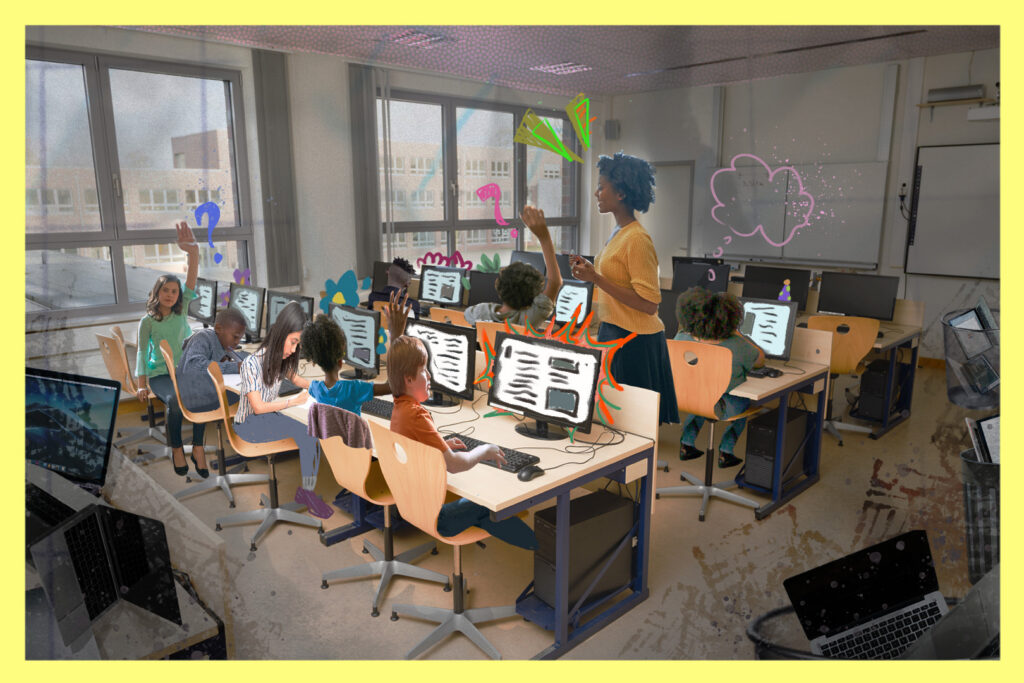
That’s why we need a balanced, old-school solution: the computer lab. At 17, I’m creaky and ancient, so I’ll explain for freshman readers. Every school would have a few rooms (most still have them from the days of yore) with lines of desktop computers, 40 solid. Computer work for classes would get done there.
Only some classes could use them at a time, but that scarcity may not be the worst thing. Teachers would have to judge the amount of time their students get on the internet, which prevents hours of the kind of mentally vacuous scrolling that we know terrorizes attention and learning.
One thing we definitely cannot do is have business as usual in schools, but without any kind of computers at all. This would exacerbate resource disparities: Classes today require the internet, and some kids just don’t have it outside school. So all at-home work would be on paper for the sake of those students. Online research would have to be done in class, and just like that, students use their time wisely. Teachers who need devices every day (coding classes come to mind) could get a set for their room, but most could adapt easily to the new hardware, for everyone’s benefit.
In time, the lab approach would almost certainly pay for itself in savings on new Chromebooks and their inherent up-to-the-minute repairs. A Chromebook costs a couple hundred dollars and is supposed to last four years but realistically will last three. A desktop for twice that price will last, given the right treatment, 10. Besides, 40 computers for a school is cheaper than a laptop for every student.
With a Department of Education run by budget slashers, this change will have to start on the state level, where fiscal conservatives and education hawks can agree (for once) that dumping money every year into fragile laptops that make learning worse is a miserably bad idea.
This fall, we are finally at a place of skepticism toward new machines. College grads are booing commencement speakers who talk up AI. Groups of teens are rebelling against social media. People everywhere are buying dumbphones. As the work to stop creeping technocracy in the lives of young adults escalates, the work to reverse its worst effects has to begin, and it should begin, as so many things do, in the classroom.